Text Box: You can generate $2.00 for the LRRP/Rangers association

The 75th RRA will reimburse us for each 1st Cav LRRP/Ranger who joins the 75th RRA


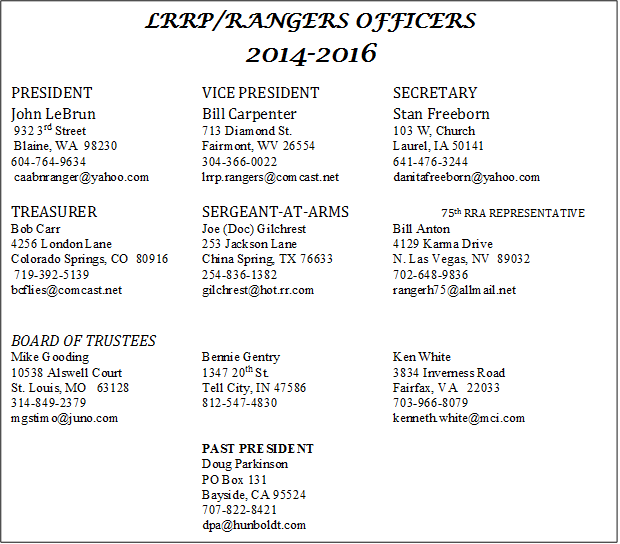
LRRP/RANGERS OFFICERS

2012-2014


PRESIDENT                           VICE PRESIDENT                 SECRETARY

Doug Parkinson                                   John LeBrun

PO Box 131                                             932 3rd Street

Bayside, CA  95524                              Blaine, WA  98230                              VACANT

707-822-8421                                          604-764-9634

dpa@humboldt1.com                          caabnranger@yahoo.com 

TREASURER                          SERGEANT-AT-ARMS          75th RRA REPRESENTATIVE

Bob Carr                                                Joe (Doc) Gilchrest                              Bill Anton

4256 London Lane                               253 Jackson Lane                                 4129 Karma Drive

Colorado Springs, CO  80916             China Spring, TX 76633                      N. Las Vegas, NV  89032-5009

 719-392-5139                                        254-836-1382                                         702-648-9836

bcflies@comcast.net                           gilchrest@hot.rr.com                           rangerh75@allmail.net


BOARD OF TRUSTEES

Mike Gooding                                       Bennie Gentry                                       Ken White

10538 Alswell Court                             1347 20th St.                                           3834 Inverness Road

St. Louis, MO   63128                          Tell City, IN 47586                                Fairfax, VA   22033

314-849-2379                                         812-547-4830                                         703-966-8079

mgstimo@juno.com                             macv495soglrp@sbcglobal.net         Kenneth.white@mci.com


                                                PAST PRESIDENT                                            

                                                Keith  Phillips      

                                                18288 Acre Lane

                                                Kemp, TX 75143

                                                darby7172@embarqmail.com


Presidents Report 2011-12

From Doug Parkinson

      Gentlemen; Thank you to those of you have made this organization a sustaining operation either by submitting your dues (even though intermittently), to those who’ve extended financial support to members attending reunions whether it’s purchasing a meal or a bus ticket home, anonymous donating to the funds and joyfully purchasing tickets to our annual luncheon raffle for items that are rejects from  the ‘Antiques Road Show’.


 Thank you ‘Reunion Angels’ that maintain the hospitality room and do a thorough cleaning.

      Special thanks to Ken White for making  the crossed sabers possible my baseball hat is getting crowded with pins. That issue generated more member comments on the website than I’d seen previously on any issue.

      Let us not forget our members or their spouses who will not be with us any more except in spirit. Those who passed this year. Some of these I served with and I know I have missed an unreplaceable opportunity to share our common past history.

      Thanks Ken White for the contribution to the Saber about LRRP/Ranger activities and hosting or meeting members that visit D.C. on Veterans Day. Hope to make it back again sometime (maybe with Bob Carr again, with spouses).

      Thanks Bill Anton for arranging the ceremony at Ft. Lewis at the 2nd Bn 75th Rangers. A memorable event. Were we that young? I swear it appeared that most of them weren’t shaving yet.  Thanks for getting members articles into ‘Patrolling Magazine’. (another outlet for historical occurrences).

      Thank you for those of you who have and are making members aware of their VA benefits that allow them to make life a little bit easier. There are still members out there who need some encouragement so let’s keep bringing in flock.

      Thanks for those who’ve filled offices in the past and those of you who will step forward in the future.

Doug

----------------------------------------------------------------------------------

YOUR LRRP/RANGERS Association needs a secretary

Someone step forward and take the position

Recording the minutes at the annual meeting is the major part of the job.


LRRP/RANGERS REUNION JUNE 5-9, 2013

Schedule and registration forms are enclosed in this newsletter


Information concerning Ranger Rendezvous 2013.

 Formal invitations will be sent later.  There will not be a website this year, as everything is being input on the Facebook page.  If you know I am missing anyone, please contact me with their email address.  This list will be my eInvite list for everyone, so I need to have the most current information available.

 http://www.facebook.com/#!/pages/The-75th-Ranger-Regiment/190158030999896?fref=ts


Ranger Rendezvous is a unit tradition to bring the entire Regiment together for the 75th Ranger Regiment's change of command. The days leading up to the ceremony are filled with Ranger demonstrations and events.

A more detailed schedule will be available in early 2013.

Contact email: "Davis Linda C Ms (75RHQ)" davislin@soc.mil


VICE PRESIDENT’S REPORT                                                             

January 2013

From John LeBrun


      Greetings and salutations from the Pacific Northwest and hope everyone had a great Thanksgiving, Christmas and New Years.

      The end of the year is fast approaching and plans for next year’s reunion are being made.   Already looks like a record number of members are planning on attending the reunion. If you haven’t made your reservation you should make them now. The Shilo Inn fills up fast and its central location make’s it a convenient place to stay.

      Once again we will be hosting our raffle after the luncheon. Members continue to bring excellent prizes that are available to be won by one and all. If you are not attending and would like to donate some thing give it to a member attending or mail it to the Shilo Inn in care of me. Thanks again for all your support in this endeavor it goes a long way in making the event very successful.

       We are still without a secretary. Some one needs to step up and assume the duties. Really not a lot to do but it has to be done. If you are interested email me or Doug Parkinson. 

      I hope this winter to add another section to the “Legacy” folder. I am putting together team pictures with the after action reports that were filed. Hope to put some faces to the narrative. If you have any Intsum’s, debriefs or other document that speak to the actions in the fields I would appreciate you sending me a copy. I have been a little neglect in updating the photos but hope to correct that this year. If you can help by identifying any of the members in the pictures it would be greatly appreciated. There is a link on the site that provides an easy way to get your comments to me.

        Barbara who is doing the bulk of the work on the legacy folder has included an article in the newsletter about a treatment (TRE); Trama, Releasing,Exercises, that seems to be getting great reviews from those who have used it. My understanding is they are exercises that anyone can do and goes a long way in reducing all types of stress. Well worth a read and a view of the testimonials’ from troops that have used it.

       Hope to see you all in Killeen this June. Until then take care and safe travels where ever you go.

John LeBrun


TREASURER’S REPORT

From Bob Carr


START 8-12-12                            $9751.24


INCOME

dues & merch                                  $411.49


DEBITS                                            

Flowers  Sam s dad                        <$ 80.00>          

newsletter                                    < $ 676.14>        

Printer ink                                    <$ 119.84>           

return newsletters to Bill                <$ 2.89>            

flowers Jurkowski                         <$ 80.00>          

merchandise for unit                    <$ 405.00>        

  TOTAL of debits                       <$1363.87>


BALANCE as of 11-30-12                 $8798.86

brick fund balance $1174.00 in same acct.


FROM 101 SOLDIERY THOUGHTS

15. Going through the change, has nothing to do with the female senior officer’s uniform.
16. Sexual harassment is a two-lane road.
17. Soldiers tell the truth about good and bad commanders. Their opinion is the ultimate evaluation of an officer.
18. No commander was ever hated for being too hard. But, many are detested for trying to cultivate that image,


DEDICATION OF 2D BATTALION 75TH RANGER REGIMENT MEMORIAL


      On 7 November 2012, 2d Ranger Battalion dedicated its new memorial at Joint Base Lewis-McChord. Mrs.

Anne Rudder Erdman gave the keynote speech. She is the daughter of then LTC James Earl Rudder, Commander of

2d Ranger Battalion during the assault on Pointe Du Hoc on 6 June 1944. MG (Ret) Rudder was later President of

Texas A&M university. LTC Gregory Anderson, Commander of 2d Battalion gave his remarks concerning 2d

Battalion history and the dedication. CSM Daryl Thies was in formation. COL (Ret) Mike Okita, Chairman

of the Pointe Du Hoc Foundation gave his remarks.    


Uncharacteristically, the sun was shining and there was no rain at the ceremony.  Wreaths for all wars that Rangers have fought in were laid during the ceremony.

      Attending the ceremony and representing Company H (Ranger) 75th Infantry (Airborne) was LTC (Ret) William T. Anton, RHOF 2009.

ED:  the name of each of our 1st Cavalry LRRP/Rangers Brothers who died in Vietnam is on this memorial.


PART OF THE MISSION STATEMENT

OF THE 75TH RRA

To organize and unite those eligible for membership in a fraternal bond: to pay homage to units in which we served by perpetuating the history and traditions of those units, and, to honor our comrades, living and dead, whose service was in keeping with the duties and responsibilities of American Rangers.


RANGER RENDEZVOUS 2013

JULY 22-28TH

COLUMBUS/FT. BENNING, GA

HQ Airport Holiday Inn North

2800 Manchester Expressway

Columbus, GA 31904


Powerful Solution for Vets With PTSD Issues:

Simple Tension & Trauma Releasing Exercises (TRE)

Whether you are a soldier suffering with PTSD or someone with too much work stress, you can benefit TRE.

Submitted by Barbara Podor, LRRP

Legacy Administrator (with John LeBrun)


 TRE is a set of six simple exercises that help to release tension from the body that accumulates from everyday life, prolonged stressful situations, or traumatic life experiences (i.e., natural disasters, war). The exercises are a simple form of stretching and are used to gently trigger voluntary muscular

shaking, known as neurogenic muscle tremors.

      Once the technique is learned and mastered after several sessions, the warm-up exercises can be accelerated or replaced with your normal exercise activity and the technique then becomes a quick and effective method for consistent relaxation. Eventually, these tremors will evoke themselves naturally in a rest position to reduce

any tension that built up over the course of the day.

      TRE is being used by thousands of people around the world as an effective tool for releasing chronic traumatic stress, physical tension and

emotional trauma.


Who Can Benefit from TRE?

      Since this shaking mechanism in the muscles is part of our natural behavior as humans, if you’re human, you can benefit from TRE. This shaking of the muscles causes deep relaxation, which naturally reduces stress levels and has also been reported to reduce pain, increases mobility and aid in tthe

healing of past injuries.


Support for Our Soldiers: Returning From War

      A recent study in the New England Journal of Medicine determined that six out of every ten soldiers returning from Iraq are suffering from Post Traumatic Stress Disorder (PTSD). These numbers are likely to increase since PTSD symptoms may

sometimes take up to two years or more to manifest themselves. This is an alarming percentage of soldiers with mild to severe PTSD. Many of

these soldiers may not seek help because of:

• Fear of being stigmatized.

• Seen as having psychological weaknesses.

• Fear that their careers may be jeopardized if they seek help.

      Growing numbers of reports are revealing the painful stories of family tragedies, like deaths and suicides resulting from unacknowledged and

unresolved PTSD symptoms. If we address the trauma recovery process constructively, our military personnel and their families could be greatly assisted in their recovery process.

      There are three major areas of trauma that should be recognized in military personnel returning from a war zone.

1. Biology of Trauma

2. Neurology of Trauma

3. Anatomy of Trauma


1. BIOLOGY OF TRAUMA

      During war and violence, the body protects itself by producing large quantities of adrenaline. producing a hyper-

arousal response, which is

necessary to protect the person during war. Additionally, the body reduces its production of serotonin, which is a

drug that inhibits impulsive behaviors. Decreased serotonin in humans has

repeatedly been correlated with impulsivity and aggression.


      The combination of increased adrenaline and decreased serotonin is precisely what causes an otherwise normal person to act out of aggressive

emotions. If the levels of adrenaline and serotonin were properly balanced, they would be able to refrain from acting from a defensive, hyper-arousal

response.

      The difficulty arises when we withdraw the individual from the danger environment and immediately return them to normal environments.

Their biochemical responses are still highly activated so that minor, everyday stressors create an exaggerated


issues that would otherwise not disturb that person now become extreme problems with life/death

intensity associated to them.


Symptoms that may indicate chemical imbalances are: mood swings, hyper-aroused reactions,

exaggerated startle responses, social withdraw or depression.


2. NEUROLOGY OF TRAUMA

      During war, the thought patterns of the brain are dramatically rerouted to engage a more primitive survival thought process used only for

emergencies. The longer an individual is in a trauma-inducing environment or the more intense the traumatic experiences, the more deeply engrained these defensive thought processes become. When the person leaves the trauma environment, this more deeply-engrained thought process now becomes the preferred pathway of even minor stressors. They’re unable to regulate their neural responses to an appropriate level.

Their responses to minor stressors are still dialed up to the same intensity of someone in a life/death situation of war.


Symptoms that may indicate neurological change sare:

uncontrollable anger or rage,

irritability and restlessness

disturbing memories or nightmares,

difficulty concentrating.


3. ANATOMY OF TRAUMA

      Because the body is a living organism, it has certain protective mechanisms built into it that react instinctively during times of danger. These

mechanisms contract the body pulling the muscles tightly together for protection. However, if an individual must live with tightly contracted muscles, after a while the body learns to live in the contracted state even though the danger has subsided.

      General exercises usually do not rid the individual of these deep chronic tension patterns. However, Trauma Releasing Exercises (TRE) can relieve the individual of very deep chronic tension patterns created during the time of severe stress trauma. If individuals don’t listen to their bodies

after living through traumatic events, they will usually carry with them deeply embedded patterns of tension

that will eventually take a toll on the body’s structure and function.

Symptoms that may indicate a chronic contraction in the body are:  lower back pains, neck and shoulder aches, gastrointestinal problems, chronic headaches


A REAL SOLUTION

      TRE is an easy to learn, pain-free way to begin healing decades old injuries, in mind and body. Then you’ll be armed with an incredibly effective

method of managing stress .

      For proof of what it’s done for some vets, including ones from Vietnam, go to:

http://traumaprevention.com/2011/01/

04/veterans-use-tre-to-recover-fromptsd/

To find TRE practitioners in your area,go to:

http://traumaprevention.com/2009/11/

12/list-of-certified-tre-practitioners


VIETNAM NUMBERS

39,996 on the Wall were just 22 or younger.
The largest age group, 8,283 were just 19 years old
3,103 were 18 years old.
12 soldiers on the Wall were 17 years old.
5 soldiers on the Wall were 16 years old.
One soldier, PFC Dan Bullock was 15 years old.


MEMORIES

From Bruce Cain


      I get many flashbacks when the guys write what they remember, thanks..... There was a comment in the last newsletter about needing items for the history display... I in fact have 2 boonie hats, one was the one I wore ( and I have pics with it on the head) , with the ponytail we all put on them, made of chute cord.


  I placed it in my hold baggage, got it home and it's still in the shoe box, along with other memories....But the second hat is the most special.  As I was leaving the AO, ( going home) I got some new greens and a new hat to travel in.  As I was getting on the helicopter, Dish walked up to the pad with me, we were shaking hands when the wind from the blades lifted my new hat off and down the air pad.. Dish didn't miss a beat, took his tiger hat off, put it on my head and said "for you Mr. Bruce", we both laughed, me not thinking much of it for the moment.   For years it sat in a box as I went thru a bad part of my life,

      ..............This week I got a e-mail from Parky, my first contact with a LRRP for 20 years, I pulled my boxes from the attic, went thru the stuff..  I had placed the tiger hat in a box along with some NVA items I kept from a kill on Signal Hill, the smell from the blood on the belt that the sniper had worn, almost made me drop to my knees.  My wife looked at the blood stained items and ask me to get rid of everything.  I told her the tiger hat wasn't going anywhere.

      Both hats are right here in a shoe box, next to my desk, along with pics of Bob Whitten, and Robert Noto. After Nam I never really tried to follow up on the unit, I did try to get in touch with Ankony one time while riding thru Detroit.  But I found out he was a cop and that really wasn't the kind of folks I'd been hanging with at the time.

      Dish , Pong, and Kit have always  made me wonder if I ( we ) could have done more for them. Those guys kept us alive on many a mission, I for one owe them and will never be able to repay them for their leadership in their country...

      If you have any use for the boonie hats, give me a yell.  I'm sure when I'm gone they will end up in a garage sale or even worse, the trash.

      Each of us deal with our Nam experience in a different way. For me getting married to my high school sweetheart was a God sent.. She's always there, and never brings up my old Nam letters, I'm very lucky, I wish all LRRPs the same....

Best Wishes for the Holidays

Bruce Cain

OBITUARY

Tom (Ski) Jurkowski

Jurkowski, Thomas K., 71, passed away at The Villages Hospital on Monday, September 17, 2012 in The Villages, FL. Born in the Bronx, NY

       Thomas Jurkowski was a world traveler who lived in Vietnam, Iran, Israel, Saudi Arabia, Iraq and throughout the United States. Thomas served in Europe and two tours of Vietnam as a long range reconnaissance patrolman in the US Army.

      As a devout Catholic, he will be remembered for his generous charitable contributions to orphanages in Vietnam and the church.

      Thomas is survived by his wife, Anh Dao; his brother, Joseph Jurkowski; six children, nine grandchildren and three great-grandchildren. His family will receive friends on Friday from 5 to 8 p.m. at the funeral home with a prayer service. Mass of Christian Burial will be Saturday, 11:30 a.m. at St. Gregory the Great Catholic Church. Interment will follow at Evergreen Cemetery. Arrangements by T.M. Ralph Plantation Funeral Home, 7001 NW 4 St., Plantation, FL. 33317, 954-587-6888 http://www.tmralph.com/.

--------------------------------------------


Whenever I have a bad day, I just think about the fact that I could live in North Korea. Suddenly, my day seems pretty  awesome ...


HISTORICAL OCCURRENCES

Bu Gia Map

by

Chuck Coffin


[Everything in this narrative is based on my 40 year-old memories.  If there are errors or omissions, they are unintentional.  We are always the viewpoint character of our memories, so my recollections may differ from others who were there.  This was one month before my 23rd birthday.]


                You can find it on Google Earth.  Type in “Bu Gia Map, Vietnam” and watch the map move from wherever you are, to southeast Asia, then narrow in on “Bu Gia Map National Park.”  There’s a village there, too.  Expand it, get closer to the ground and the terrain.  Narrow down on the mountains, see how rugged the terrain is, how thing the vegetation.  Go northwest from there, towards the border with Cambodia, and there’s a place where the border forms almost a peninsula of Vietnam into Cambodia.  There are no roads near there on the Vietnamese side, though you can see one in Cambodia.  Which is probably why we were there.  As near as I recall, that’s the place on the border where we were.  Somewhere along there, for sure.

                March 25th, 1970.  Give or take a day.  My last mission before Recondo School, and just over a month before President Nixon ordered US forces into Cambodia.  Some missions fade, some blur into others.  But parts of this mission are etched into my memory, never to be forgotten.  I can still smell the earth and the rotting vegetation, can feel the heat, hear the bugs buzzing around me.  Rick Arden was Team Leader; I was Assistant Team Leader.

                We were told we’d be conducting a mission along the Cambodian border, “north of Bu Gia Map,” a place I’d never heard of.  We were supposed to be on the Vietnamese side of the border, but I knew the exact border location was, shall we say, subject to interpretation, especially in those mountains.

                We flew up to a little Fire Support Base, and it scared hell out of me.  It had, literally, one strand of concertina wire around it.  While I was putting on my camouflage before insertion, using a truck mirror, some black guy came up to me and watched me for a minute.

                “You one of them Rangers?” he asked.

                In my best John Wayne/Gary Cooper/Clint Eastwood laconic imitation I replied, “Yep.”

                “You going out there?” he asked, pointing vaguely north.

                “Yep.”


He considered this for a minute and then said, “Man, you crazy!  Ain’t no way I’d go out there!”

                I looked around at the tiny FSB—I could throw a rock from one end to the other—and at the single strand of concertina wire, thought about one reinforced squad of NVA being able to overrun it in about five minutes, and said to him, “Man, YOU the crazy one.  No way I’d stay here!”

                I don’t remember much about the insertion.  I think Rick is right, this was the one where we were inserted on the side of a very steep hill, something like a 30 degree slope.  That’s very rugged terrain there.  I think I recall being on the “low” side, being able to step off the Huey skid directly onto the ground, while Rick and the guys on the other side had to jump about 10 feet to the ground.  I remember being very scared, as we’d recently been told of an insertion made on similar terrain where the pilot over-corrected when the “high” side guys jumped off and the chopper rocked, decapitating two of the guys on the “low” side.  Troop of the Blues, I think.

                But the insertion went without incident, and the chopper left, leaving us in the silence that was always surprising.  We waited out the stillness, wondering if anyone had seen us come in.  We made commo and moved out.  I think nothing happened that day, and I believe we RON’ed that night, and continued to move the next day.

                I think it was early morning of the second day, on the top of a hill—or mountain—we found the trail.  It was a cool morning for Vietnam, only about 85 or 90 degrees.  And the trail was a wide one, maybe 6 or 7 feet wide.  Recent heavy use. 


Page 9

                So we set the ambush.  Daisy-chained a bunch of claymores along thirty feet or so, with the one at each end pointing down that trail’s direction.  I remember Rick looking for a suitable place to hang a grenade or two at head-height and work it into the daisy chain, but the vegetation there was heavy with

 bamboo, and he didn’t find one he could camouflage to his satisfaction. I had recently come up with the idea—or stolen it from someone else—of putting a concussion grenade in the center of the kill-zone, the idea being we’d kill everyone in the zone but one, and have ourselves a prisoner—and a three-day in-country R&R (I remember Ted Scherk tried for 102 days R&R after he captured 34 Montagnard men, women and children.  The CO threw Ted out of his office).

                Usually we’d set the ambush and wait.  Usually, nothing happened, and after a day or so we’d pack up and go somewhere else.  So I was settling in for a long wait, and had just started heating water in a canteen cup for my noon meal using a dab of C-4 —beef and rice, my favorite.  The water had just come to a boil and I was readying the packet when someone whispered sharply, “We got Movement!”  I scrambled quickly into position, knocking over my water, but paying no attention.  Rick and I grabbed the “clackers” for the claymores.

                And now I was really frightened. 


                I have never, ever believed they were NVA.  I have always thought they were Chinese.  These guys were big, stocky, maybe weighing 160 or 170 lbs or so.  Their skin was much darker than Vietnamese, and they seemed much healthier.  They were wearing heavy packs, but they were bouncing along, full of energy.  They had, we learned later, fresh haircuts.  They were muscular. They had to have just left a base camp, fresh and rested.

                And they were happy.  They didn’t have a care in the world, and they acted like they were on a holiday, or a fun jaunt through the woods.  They never suspected there was anyone else around.

                Rick grasped his “clackers” and I grasped mine.  “On three,” he said.  “One…Two…Three!  And we squeezed the clackers and blew the claymores.  I was no longer scared, and wasn’t for the rest of the day.  Too busy, too many things to do.

As always, the noise was tremendous.  More so than usual, we were closer to the claymores than we should have been, but the terrain didn’t allow us much option.  I was partially deaf for a few days (and acquired a hearing problem that persists to this day, and continues to worsen.  But the VA doesn’t recognize it).  We fired our weapons, threw grenades, put out fire all along the trail.  And received return fire.  While lying on my stomach, I felt a hot burn on my back, near my spine at the level of my shoulders.  I had been hit by shrapnel.  Not badly, but I still have the small scars.  I remember PFC Tomlinson also got some shrapnel in his leg.  I don’t remember if anyone else was hit. 

                After a while—five minutes?  Fifteen?  I have no way of knowing—return fire ceased.  We waited, watched, saw no sign of activity.  After a bit, Rick said, “Let’s check the kill zone.”  As ATL, I led the way, while Rick was talking on the radio.

                I was a few meters ahead of the others, stepping over the tangled brush, walking point, when from the kill zone, someone popped up and unloaded his AK-47 at us.  So much for concussion grenades and taking a prisoner.

                Rick says that I fell “like a sack of potatoes.”  He’s right.  I hadn’t had much martial arts training at that point, but I had learned that the fastest way to hit the ground is not to “throw” yourself, but to relax and utterly collapse, which I did, pulling my M-16’s trigger as I did.  Nothing happened.  I must have looked like I’d been killed, without a chance to fire back.


                I heard someone shout “The sonsabitches killed Chuck!” and heard the entire team open up, hosing down the area, while I frantically worked the charging handle on the M-16 and managed to feed a round into the chamber—which was empty.  What the hell?

                I ran a couple magazines through, then crawled backwards to where the team was back in our original ambush position…or, as I put it in an attempt at humor, “I set the world’s record for crawling backwards, on one’s stomach, wearing a 60-lb. rucksack!”  Once back with the team, we all put out more fire.

                I felt a burning along my right side.  Didn’t have time to mess with it then, but much later I realized that a bullet had come right along my side, burning it, but never breaking the skin, like a hot iron laid against my side.  There’s still a faint scar there, though there seems to be a few more rolls of skin now than there were back then.


                What had happened to my M-16?  Stupidity is what happened.  My stupidity.  I thought I was smarter than the Army.  They issued us 20 round magazines, and then told us to only load 18 rounds into them.  “That’s dumb,” I thought.  “Twenty round magazines should hold 20 rounds; I might need ‘em.”

                No, the Army was right.  Loading 20 rounds into the magazine creates so much pressure on the spring and the rounds are packed so tightly that when the bolt goes forward, it can slip over the top round, chambering…nothing.  Which is what had happened.  I’d been walking point with no round in my chamber.  I’ve told the story over the years to countless young troops, as an object lesson:  Sometimes the Army has a reason for telling you to do something in a certain way.

                We kept firing, and receiving return fire.  Then I spotted muzzle flashes from some thick brush by the trail.  I sighted carefully on the spot they were coming from and fired three rounds.  No more muzzle flashes.  No more return fire, either.  I’ve always been proud of my rifle shooting.  I’ve won some awards, but that was the most important shot I’ve made, I think.

                After a bit, Rick said, “Let’s go check.”  He turned to me, and asked, “You want me to lead?”

                “No,” I said, “I’m ATL, and it’s my job.  You keep talking on the radio and get the birds out here.”  But I was a bit shaky about it.  And I did check to make certain I had a round in the chamber.

                We got to the kill zone and spread out.  With a “newbie,” (whose name I forget--if you read this, my apologies) I went left to the end of the kill zone where there was a body.  I told him to watch down the trail to make certain there were no reinforcements coming, “And if I see you watching me instead of the trail, I’m gonna butt-stroke you,” I told him.  “No problem!” he agreed vigorously.  And his eyes never left the trail.

                “No problem,” he said, and I began stripping the body, searching the pockets.

                “This one’s still alive!” I heard someone shout behind me.  I turned, drawing the Browning Hi-Power 9mm I carried, and saw one of the Chinese sitting up, groping for something, maybe a weapon.  I was bringing the Browning around, when Rick took a step toward him and fired his M-16.  The bullet hit the guy above the eyebrows and took off the entire top of his head.

                I remember being surprised he didn’t die like they do in the movies.  No dramatic flopping back, or being hurled back.  Instead, he groaned, and slowly, slowly leaned back, finally settling on the jungle floor, as the last of his energy, and his life, left him.

                We finished searching and stripping the bodies.  We took the rice packets they were carrying—we knew that somewhere there were guys who could do forensic analysis and tell where the rice had come from.  Papers, of course, and anything else we could find that could provide intel.

Sometime during that period, the Cobras got on station, and scoped out the area.  “You’ve got movement, 360!” they told Rick, and came down and hovered above us, firing rockets and mini-guns, while turning a 360 over us.

                We began to realize we’d stirred up a real hornet’s nest.  We were surrounded, on top of a mountain, and no place to go.  No way we could make it back to our insertion point.  And there was no PZ anywhere near us that we knew of.  The trees were too thick and too tall to allow anything to get near us.  These were mountain hardwood trees.

                One of the Huey pilots came on the air:  “Move 200 meters northwest,” he told Rick.  So we headed that direction.  Did we take one of the bodies?  I have the vague memory that maybe we did, but I’m not sure about that.  The thought being they could do a forensic analysis on the body, even though CSI wouldn’t come on television for 35 years.  Maybe we just discussed it.  As we left that area, I stepped over the body Rick had shot a second before I had.  I could see bone chips and brains, but no skull top.

                We got to the location the pilot directed us to, and looked around.  We were in bamboo, thick stalks rising 10 or 12 feet in the air.  And wondering, what was going to happen next.  A helicopter couldn’t land in the bamboo; why had he directed us here?

                Then the pilot did one of the bravest things I’ve seen.  Using his helicopter blades like a weed-whacker, he lowered his Huey into the bamboo, cutting it down.  Even today, I’m astonished.  Pilots can be such picky guys, and they hate FOD—Foreign Object Damage.  I’ve seen pilots refuse to land on a chopper pad if there was a scrap of paper on it.  But this guy was cutting his way into the bamboo, splinters, leaves, stems flying everywhere.  He must have had his own personal wheelbarrow to cart his brass ones around.

Page 11

      When he had carved a hole in the bamboo thicket deep enough for us to reach the skid, we started handing up our equipment, the captured equipment, the dead body (?), and finally each other, as the door gunner and the crew chief frantically pulled us up.  When we were all aboard, the pilot tried to lift us out.

                But the helicopter wouldn’t rise out of the leafy bowl it had cut.  Thinner mountain-top air, 6 Rangers and a dead body, plus the crew, and perhaps an older model Huey…it just didn’t have the lift.  And the Cobras told us the movement was getting closer.

                We started tossing things out to lighten us.  The dead body (if there was one).  Then our packs (including my favorite PZ-cutting knife.  The packs were recovered a few days later when someone went in on a Jungle Penetrator).  Then the equipment we’d taken off the bodies.

                Finally, the helicopter began to rise.  Slowly, slowly, it pulled itself up above the lip of the bamboo bowl we were in.   Straining almost like a living thing, as we were urging it up, it finally slipped over the bowl, and started down the mountainside.  It still didn’t have the lift to get out of there, so it was building up speed “sliding” down the side of the mountain.

                As we “slid” down the mountain, I could see sparkles throughout the greenery.  They were pretty, like a Christmas display.  It took me a few seconds to realize that those were muzzle flashes of people shooting at us.  We truly had been surrounded, and if not for the Cobra and Huey pilots, we would have had a very bad time indeed.

                When we got back, Rick and I put the “Weed-whacker” pilot in for a DFC, but I never heard if anything came of it.  Probably not.  Most likely all he ever got was our most heart-felt thanks.

                And just over a month later, May 1st, 1970, while I was finishing up Recondo School with 5th Special Forces Group at Nha Trang, American forces went into Cambodia to wipe out those sanctuaries.

*  *  *   *

                Chuck Coffin

H Company (Ranger), 75th Infantry (Airborne)

October 1969 – October 1970

LTC (ret.) US Army, Special Forces


NONFICTION BOOKS

by and about LRRP/Rangers

in Viet Nam


The Ghosts of the Highlands by Kregg P.J. Jorgenson, Ivy Books.  This is about the beginning of the 1st Cav LRRP/Rangers, 1966-67


LRRP Company Command by Kregg P. J. Jorgenson, Ballantine Books. 

The 1st Cav LRRP/Rangers, 1968-69


Acceptable Loss by Kregg P. J. Jorgenson, Ivy Books.  Kregg’s autobiography, 1969-70.


MIA RESCUE LRRPs in Cambodia by Kregg P.J. Jorgenson, Ivy Books.  One mission gone bad during the Cambodian Invasion.


Above All Else by Ron Christopher, PublishAmerica.  Ron’s autobiography about being the TL of the first team to pull a mission

as the 1st Cav’s LRRP/Rangers.


One-Zulu by Curtis “Randy” Kimes, published by author.  About one mission, May 7-9, 1968.


 Lurps: A Ranger’s Diary of Tet, Khe Sanh, A Shau, and Quang Tri by Bob Ankony

University Press of America, of Rowman and Littlefield Publishing group, 1967-68


OTHER BOOKS


For What It’s Worth by David Klimek, published by author.  Dave’s experiences during the Cambodian Invasion before he joined H-75th.


A Troop, 9th Cavalry by Ron Christopher. PublishAmerica.  Ron’s experiences with the “Blues” A-1-9 before he joined LRRP.


LRRP/RANGER

MERCHANDISE PRICE LIST


T-Shirts:    Black/White sizes to 4X

 $13

T-Shirts Novelty: White  sizes to 4X 

$10

T-Shirts Recondo: Grey sizes to 2X

$15

Golf(Polo)Shirts:Blk/White sizes to XL

  $30

Sweatshirts M to XXL

$20

Windshirts:Pullover: Black M LR XL       

$36


Windshirt:      (converts to sleeveless)

Black With Khaki Trim:   M  L  XL

$48

Hats:                  Black or White

$12

Ranger Ring:       size 101/2 only

Watches:          Ladies and Mens  

$50

$30

Belt Buckles:          numbered

$20

Ranger Lapel Pin:

$4 

Cloth Scroll Patch:    (Co H 75th Inf.)

 $4 

Cloth Logo Patch:

$4 

Wooden Nickel:

$1 

Ankony's book; LURP's

$30 

DVD's  1 James Gang

           2 Bear Cat Training

           3 Tribute To Our 

              Fallen Comrades

           4 History Channel LRRP's

$15   

each  

Decals:   interior/exterior

$2    

  ANNUAL DUES

$15   

 Shipping per order

$5    

Please mail check/money order payable to LRRP/RANGER

Bennie Gentry

1347 20th  St.

Tell City, IN 47586

812-547-4830

macv495soglrp@sbcglobal.net

The $5.00 shipping charge covers only one or two shirts.  Donations are gladly accepted


VA UPDATE

FROM John Simones

Congress to Decide on 2013 Tricare


Rx Fee Hikes

As published by military.com

Tom Philpott | November 24, 2012


      The House and Senate will decide in the next few weeks how military pharmacy fees will be raised in 2013, a step that arguably will be the most significant taken to date to slow growth in military healthcare budgets.

      Out-of-pocket costs for military families and retirees who have prescriptions filled in the TRICARE network of retail pharmacies depend on final language in the fiscal 2013 Defense Authorization Act. Congress intends to pass a final defense bill by mid-December.

      The House-passed plan for pharmacy fees could win over Senate colleagues during final negotiations on the bill. It already is more palatable with military associations. It calls for more modest co-pay hikes than proposed by the Obama administration. But it would achieve the same first-year savings by requiring beneficiaries 65 and older to use the TRICARE mail order pharmacy program for refills of all maintenance drugs, those that control chronic conditions like high blood pressure and diabetes.


    Any brand name prescription filled by mail rather than in drug stores or supermarkets saves the department 27 percent, on average, said Rear Adm. Thomas J. McGinnis, chief of pharmaceutical operations for TRICARE.

Officially the administration continues back the pharmacy fee increases it unveiled last spring. Prescriptions would remain free on base, and the co-pay for generic drugs would stay at $5 at retail outlets. But the administration plans to raise the $12 co-pay at retail to $26 for brand names on the military formulary. The formulary is the department's list of approved drugs based on price and effectiveness. The administration also wants to ban retail outlets from filling prescriptions for non-formulary drugs, forcing beneficiaries to use mail order for the most costly brand name medicines.

Also the new higher co-pays would climb by $2 more each year until reaching $34 in 2016. After that, they would be adjusted yearly based on overall medical inflation. Co-pays for brand name drugs at mail order also would jump to $26 from $9, for a 90-day supply, and then climb slowly to $34 by October 2016, under the administration's plan


      TRICARE already has authority to make these changes. The question is will Congress step in and modify the plan. The Senate Armed Services Committee, in marking up its version of the 2013 National Defense Authorization Act, stayed silent on the issue. So unless the bill is amended on the floor next week to interfere with the plan, the Senate will signal TRICARE to proceed with planned fee changes. Last June, the department even published a proposed regulation to do so, and invited public comment.

      It withdrew the proposed regulation when the House passed in its version of the defense bill with an alternative pharmacy fee plan. The House proposes bumping the co-pay for formulary brand names at retail only to $17 versus $26 proposed by the administration. It also would continue to allow prescriptions for non-formulary drugs to be filled at retail, but would raise the co-pay for these more costly drugs to $44 versus the current charge of $25.

      More significantly, the House plan would limit future co-pay increases to the annual percentage cost-of-living adjustments to military retired pay.

Given actions to date by the House and the Senate committee, some retail pharmacy fee increases are a certainty. The battle ahead is details.

After the Senate passes its defense bill, a House-Senate conference committee will smooth out any differences, including on pharmacy co-pays. McGinnis suggested the House plan could take longer to implement, delaying new fees perhaps


until April 1, given the requirement that beneficiaries 65 and older use mail order for maintenance drugs.

      "We would have to do a contract modification with Express Scripts," he said, referring to the company that administers TRICARE pharmacy programs, "so that would take a little bit longer to implement."

       Also there would have to be an aggressive information program to explain to senior beneficiaries that prescription refills must be filled by mail order. The House bill would set this


requirement for at least a year. But McGinnis said once beneficiaries try mail order, 98 percent of them like it and choose to continue to use mail order over their local pharmacies.


If the House plan does prevail, elderly beneficiaries will have time to absorb details before it starts. One of those details is certain to be a "fail safe" provision that would allow a patient to get a 30-day supply of any maintenance drug at retail if there's a hitch in the mail order process.

      TRICARE estimates that it pays an average of $324 every three months for a brand name medication filled at retail but the cost falls to between $233 and $239 through mail order or if filled on base. If beneficiaries ask for a generic substitute for any brand name drug, the department three-month cost falls to about $60.

Beneficiaries too save money with mail order because, for the same co-pay prescriptions typically are filled for 90 days versus 30 days at retail. And generic drugs are provided at no charge through mail order.

      Given the incentives and the convenience of mail order, McGinnis said usage has popped within the military community over the past year. In June of 2011, a million prescriptions a month were filled by mail. That monthly total has climbed since then to about 1.5 million.

      McGinnis said the departure of Walgreens from the TRICARE retail network last January helped in that regard. Many former Walgreens customers shifted to mail order and liked it, McGinnis said.


"We are not getting any complaints from anybody. That really worked out well [and] saved us a lot of money," the pharmacy chief said.

      Without Walgreens, the retail network still meets contract requirements for serving beneficiaries, McGinnis said. In urban areas, 91 percent of beneficiaries must live within two miles of a pharmacy. In the suburbs, 95 percent must live within five miles and in rural areas, 95 percent of beneficiaries must be within 15 miles of a network pharmacy.

     Without Walgreens, the network still has 57,600 pharmacies. To put that into perspective, McGinnis said, there are 36,000 grocery stores, 14,000 McDonalds and 11,000 Star


      Stars and Stripes reports that a wide-ranging review of behavioral health diagnoses at Madigan Army Medical Center in Tacoma, Washington closed in September with Army doctors changing more than half of the cases they evaluated, giving 150 servicemembers new diagnoses of post-traumatic stress disorder (PTSD). The review followed complaints early this year about a team of Madigan forensic psychiatrists who sometimes adjusted PTSD diagnoses. Dozens of re-evaluations are still outstanding. Former patients can still have their diagnoses reviewed by contacting Madigan. They would be referred to the hospital's Integrated Disability Evaluation System. They also can call an Army Medical Command hotline at 800-984-8523.


From the Defense Finance and Accounting Service

      Beginning on March 1, @013, all payments from the federal government will be made by electronic deposit.  No paper checks will be issued.

      If you should need a copy of your 1099-R, contact:  Defense Finance and Accounting Service

U.S. Military Retired Pay

PO Box 7130

London, KY 40742-7130


VIETNAM VETERANS’ WELCOME HOME CEREMONY

From Sid Marcus

This was sent to Sid by his son, who is in training at Fort Sam Houston.
                   from:  AMEDDC&S INFO
    

 The Army at Historic Fort Sam Houston  hosted a Vietnam Veteran 50th Anniversary Welcome Home Ceremony, parade, and reception, November 7, 2012, from 4 to 7 p.m. The ceremony was held on Staff Post Field on Fort Sam Houston from 4 to 5 p.m. and was followed by a reception for Vietnam Veterans and their Families in the Quadrangle from 5 to 7 p.m.
      This ceremony and reception are a long-overdue opportunity to combine the efforts of the Army at Fort Sam Houston, our fellow service components, and the local community to welcome home Vietnam War Veterans and their Families regardless of the branch of the military in which they served. This initiative  honored not only those who served during this time, but also honor those who lost their lives in this war, those who were held as Prisoners of War, and those still unaccounted for.
      The Army team at Fort Sam Houston put together an advisory board of prominent community members to assist us in making this long -overdue celebration the very best it can be. The Welcome Home Vietnam Veteran Advisory- Board consists of:
Ø Senior military leaders
Ø City of San Antonio departments
Ø Greater San Antonio Area Chamber of Commerce
Ø Non-profit organizations
Ø Veteran Service Organizations
Ø Local business leaders and volunteers
      The Guest of Honor for the ceremony was Medal of Honor recipient, Major General Patrick Brady (USA, Retired) also a Vietnam-Era veteran.
      The official ceremony incorporated military and civilian leaders, along with military units and City of San Antonio personnel and equipment into a military-style ceremony complete with troops, music, Police honor guards, and fanfare. The grounds had static displays of Vietnam era equipment, welcome home signs and banners, yellow ribbons, and helicopter flyovers all meant to offer a celebratory environment to finally welcome these heroes home the right way.
      In addition to the ceremonial fanfare, we also presented the City of San Antonio a Vietnam time capsule. Between the 7th and the 30th of November, the Army at Fort Sam Houston is collectedg memorabilia and filming testimonials of Vietnam Veterans to include in this time capsule for future generations to learn from and remember.
      Immediately following the ceremony on Staff Post Field, guests were asked to line the “Corridor of Thanks” as the Vietnam Veterans walk into the historic Fort Sam Houston Quadrangle. The procession had signs, music, and a “ticker-tape” type atmosphere. Inside the Quadrangle the Veterans were celebrated again at a reception complete with food, community leaders, well-wishers, and Vietnam era music.

FROM ROGER’S RULES

OF RANGERING

11. If your rear is attacked, the main body and flankers must face about to the right or left, as occasion shall require, and form themselves to oppose the enemy, as before directed; and the same method must be observed, if attacked in either of your flanks, by which means you will always make a rear of one of your flank-guards.

12. If you determine to rally after a retreat, in order to make a fresh stand against the enemy, by all means endeavour to do it on the most rising ground you can come at, which will give you greatly the advantage in point of situation, and enable you to repulse superior numbers.

13. If general, when pushed upon by the enemy, reserve your fire till they approach very near, which will them put them into the greater surprise and consternation, and give you an opportunity of rushing upon them with your hatchets and cutlasses to the better advantage.


Veterans Day 2012 at The Wall

Washington, D.C.

By Ken White


      Veterans Day 2012 marked the 30th anniversary of the Vietnam Veterans Memorial (The Wall) on The National Mall in Washington, DC.  As part of this anniversary celebration, The


Reading of The Names where volunteers read the names of the 58,282 service members inscribed on The Wall took place for 65 hours over a four-day period.  This began on November

7th at 4:00pm and ended on November 10th at 12:00pm.  This was just the fifth time in The Wall’s history that The Reading of The Names was done in Washington, DC.  In November 1982, the names were read aloud at Washington National Cathedral as part of a week-long National Salute to Vietnam Veterans. The names were read at The Wall during the 10th Anniversary celebration in November 1992, during the 20th Anniversary celebration in 2002, and during the 25th Anniversary celebration in 2007.                     

      The weather for the Veterans Day observance on November 11th could not have been nicer.  It was sunny and dry with temperatures in the low-to-mid 70’s, and as you can imagine, the anniversary celebration plus the nice weather attracted a large crowd.  Special remarks were provided by Major General Lee Seo Young, Defense Attache, Republic of Korea Embassy.  General Lee noted that 326,000 Korean troops served in Vietnam, including the Republic of Korea Capital “Tiger” Infantry Division, which was based just outside the port city of Qui Nhon, at the southern end of Binh Dinh Province, in central South Vietnam.  For those of you who served with the 1st Cav between September 1965 and January 1968, you may remember that the Tiger Division’s base camp was located just south of where Highway 19 – the main east-west road through the Central Highlands, emerged onto the coastal plains and intersected with Highway 1 – the main north-south road that ran along the coast.  This was about 65 kilometers or so from the 1st Cav’s base camp at An Khe.  The Koreans had 5,099 troops killed in Vietnam and more than 11,000 wounded.  He also noted that Korean troops fought in Iraq and are currently fighting in Afghanistan alongside U.S. troops. 

      The keynote speaker for the observance was Eric K. Shinseki, Secretary of Veterans Affairs.  Secretary Shinseki graduated from the U.S. Military Academy at West Point in 1965 and was commissioned a 2nd Lieutenant.  He served two tours of duty in Vietnam with the 9th and 25th Infantry Divisions, as a forward observer, and as a commander of Alpha Troop, 3rd Squadron, 5th Cavalry Regiment.  During one of those tours, he stepped on a land mine, which blew off the front part of one of his feet.  From March 1994 to July 1995, he was the commanding general of the 1st Cav at Fort Hood.  Shortly afterwards, he was promoted to lieutenant general, and in 1999, became the 34th Chief of Staff of the Army, where he served a four-year term.

      On Veterans Day evening, the 1st Cav Association hosted the 3rd Annual First Team Veterans Day Dinner at the Crowne Plaza Washington National Airport Hotel in Crystal City.  It was another sell-out at 200 or so vets, family members, and friends.  That evening, I had the pleasure of talking with LTC. Jim Wright (1967) and Terry Smith (1970-71) at the hospitality suite.  I saw that Bob Oakes (1970-71) had signed the guest register but unfortunately we missed each other. 

      On November 28th, the ceremonial groundbreaking for The Education Center at The Wall took place just across from Constitutional Gardens on The National Mall near the Lincoln Memorial.  The Education Center will be a national landmark dedicated to bringing to life the stories of the more than 58,000 American service members who died in the Vietnam War.  It will also tell the stories of the fallen in Iraq and Afghanistan, serving as a temporary place of remembrance until today’s veterans receive their own national honor.  To date, $47 million of the $85 million necessary to commence construction has been raised.


See you at The Wall on Memorial Day 2013.


LRP RATIONS TODAY

A Taste of Home in Foil Packets and Powder

From the New York TimesTop of ForBottom of Form


Close      EARLY in the war in Afghanistan,,a single French combat ration (cassoulet, perhaps, with deer pâté and nougat) could be traded for at least five American Meals Ready to Eat, better known as M.R.E.’s.

      A fellow journalist who just got back from an embed with the French told me that they look forward to visiting the Americans for a meal. American rations — hamburgers, chili, peanut butter, candy — they say, are “fun.”

      Each year, tens of millions of dollars are spent researching how to fit the most calories, nutrition and either comfort or fun into a small, light package. The menus and accompaniments are intended not just to nourish but also to remind the soldier of home. Some include branded comfort foods — Australians get a dark-brown spreadable yeast-paste treat called Vegemite, for example — while others get national staples like liverwurst (Germany), or lamb curry (Britain’s current culinary obsession).

      Some of the contents are practical. Italians get three disposable toothbrushes per day of combat. Americans get pound cake, which military folklore says reduces the need for toilet breaks.

      The soldiers like to mix and match some of the ingredients to create their own drinks and meals. Army Rangers have been taught at least as far back as the Vietnam War how to make Ranger Pudding — roughly, it’s water mixed with cocoa powder, instant coffee, melted chocolate, Tootsie Roll, sugar and coffee creamer.

      In combat, eating is often the only good thing about a day. When a soldier or marine sits down to warm up his M.R.E., he’s not being shot at, he’s not losing friends. It’s almost a ritual, and the very act of opening one of these packages suggests safety, however brief it may be.


RUNNING SLACK

From Bill Carpenter

There is not a lot to report this issue.  I can only print what you send me.


From Ron Christopher

I have two additional books published. They are: A Question Unanswered PTSD which I think is plain regarding the title and the second book is about the life of my grandmother. She was born in the late 1800 and raised among an Indian Tribe and a KKK (klavern) group. Her mother made moonshine to pacify the two factions. Both books are a good read. I would like some feed back on A Question Unanswered PTSD. I already know that some troopes will get pissed off while on the other hand some will agree with me. It took me a year of research to complete the book so all the facts are true. Both books can be obtained from Xlibris, Amazon and other book stores.

Thanks

Ron

Fropm Garnet Jenkins

David Dickenson’s sister

      Benny and Sandy Gentry stopped here to visit for a few days on their way to the reunion this year. We had a great time. Benny even grilled steaks for us for breakfast one morning...Great meal!!!

      We spent one day traveling to Crawford, CO. To visit my brother Bobby. Benny and Bobby had never met before, it was a pretty awesome few moments, when we first arrived at his home.

      I can't tell you how much I look forward to seeing and visiting with the men from David's unit. It is ALWAYS SPECIAL!!!!

Kerry for DOD Secretary

I try to stay away from political issues in this newsletter.  But my opinion is that having John Kerry as Secretary of State is a deliberate slap in the face of everyone who ever wore a uniform.  That’s my opinion and I’m sticking to it.

STRAWBERRY FIELDS FOREVER


Democracy And Soldiering Don’t Mix

A poem from Australia


It’s true our military defend democracy but never practice it

I’m sure you will agree if you read on a bit

A soldier is governed by military rules as well as common law

Army law gets even tougher when serving during war

A warrior obeys orders and it’s frowned upon to ask what for?

There are times you can be punished twice for the same sin 

First by army law and then again in a civil court for him

There was a time a soldier needed permission to marry

Imagine yesterday’s fuss if a he wanted to wed a mate called Harry  

A weary sentry can be jailed for sleeping

Scratching an itchy nose on parade causes much weeping

Then there is the firing squad for crimes even worse

Gawd, there’s punishment from murder to a soldier’s curse

You can’t resign and freely walk away via the barracks gate

God help any soldier who for any parade is running late

Before any trial they march the guilty bastards in

It’s a daily ritual where the RSM converts everything to sin 

There’s no union to help if you work without rest, day and night

Exposed to cruel weather; hot, cold and wet without respite

Sergeants always yell and RSMs constantly scream    

Gawd, perhaps it’s a crime if you’re caught having R rated dreams 

Closed barracks and no leave is a regular blight

Stand by your bed at any hour, morning or night 

A hefty fine and the cells if you caught after shooting through 

Always the Sergeant’s call “I want volunteers, you and you”

Its part of the calling that your life is not yours to keep

So in answering the call of duty you may find eternal sleep 

And if you do survive to retire, don’t expect a comfortable life

Thanks to our Pollys, you may border on financial strife


If you are thinking of enlisting then the above is part of the score

Believe me, there’s a bloody lot more

Nevertheless there’s wonderful magic being part of such a proud mob

I swear I would never have swapped it for any other job 

                George Mansford ©July 2011


*RSM---The Regimental Sergeant Major who advises God